Recruitment Metrics Every Hiring Manager Should Track
Published on Sep 17, 2026
From Time-to-Hire to Quality-of-Hire: The Metrics That Matter Most
Why Recruitment Metrics Matter
Every hiring process generates valuable information. From the number of applications received to the time it takes to make an offer, these data points can help hiring managers understand what is working and what isn't.
For example, if a company receives hundreds of applications but very few qualified candidates reach the interview stage, the problem may be with the job description, sourcing strategy, or screening process.
Similarly, if candidates frequently decline offers, compensation may not be the only issue. The candidate experience, hiring timeline, communication, or employer reputation could also be influencing their decisions.
Recruitment metrics help hiring managers move from “We are struggling to hire” to “We know exactly where the hiring process needs improvement.”
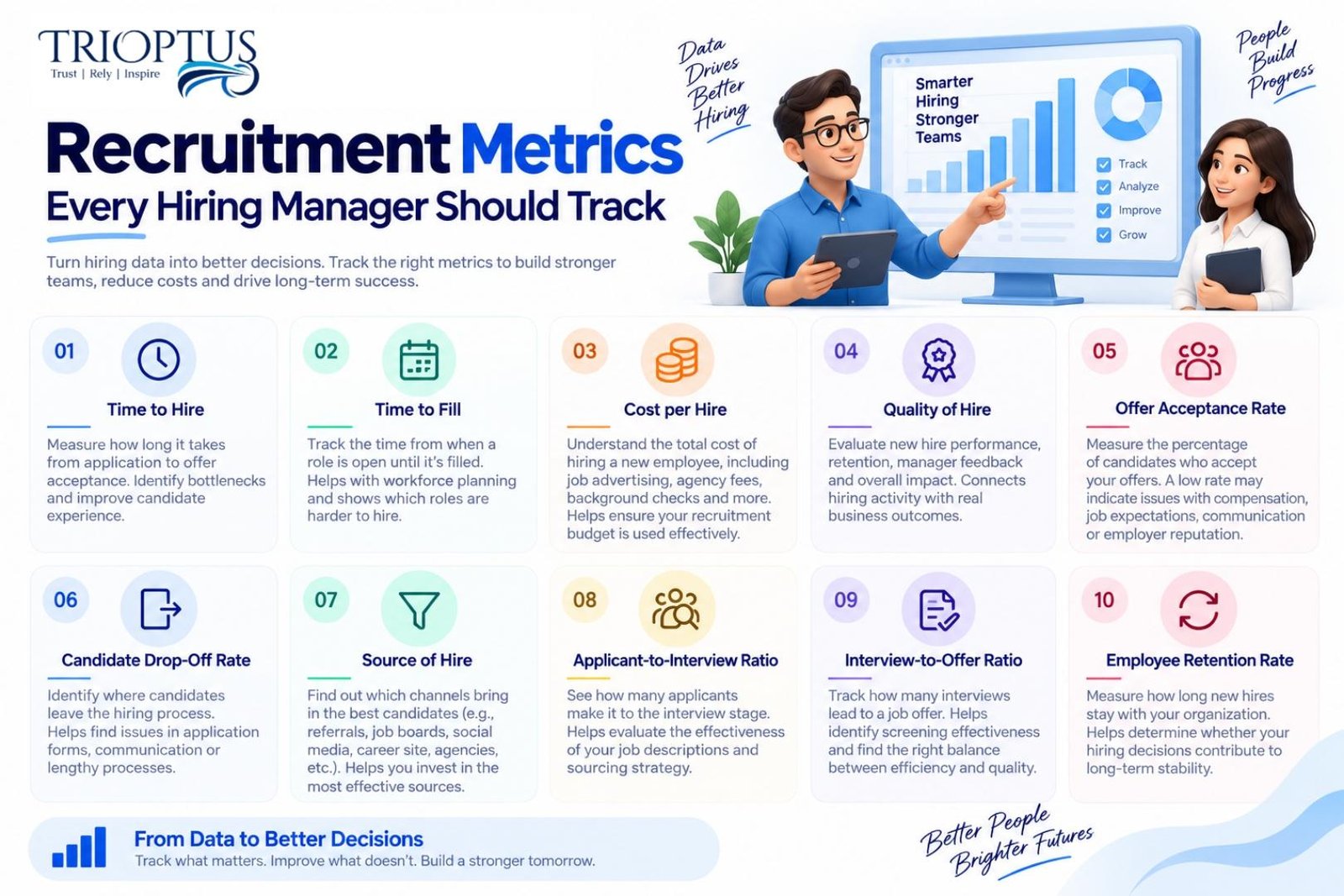
1. Time to Hire
Time to hire measures how long it takes to move a candidate from entering the recruitment process to accepting an offer.
A lengthy hiring process can cause organizations to lose qualified candidates to competitors. It can also leave teams understaffed for longer periods.
Tracking this metric helps hiring managers identify unnecessary delays in interviews, approvals, decision-making, and offer processes.
Why it matters:
- Identifies hiring bottlenecks.
- Helps improve candidate experience.
- Reduces the risk of losing top candidates.
- Helps teams plan workforce needs.
2. Time to Fill
Time to fill measures how long it takes to fill an open position, typically from when the role becomes available until the position is filled.
This metric is particularly useful for workforce planning. A consistently high time-to-fill may indicate difficulty finding qualified candidates, inefficient recruitment processes, or unrealistic job requirements.
Hiring managers can compare time-to-fill across departments and positions to understand which roles require additional attention.
3. Cost per Hire
Recruitment comes with many expenses, including job advertising, recruiting software, agency fees, background checks, interview expenses, and recruiter salaries.
Cost per hire provides an estimate of how much the organization spends to bring each new employee into the company.
Tracking this metric helps organizations understand whether their recruitment budget is being used effectively.
Costs may include:
- Job advertising.
- Recruitment agency fees.
- Career fair expenses.
- Background checks.
- Recruitment technology.
- Internal recruiting costs.
4. Quality of Hire
Speed and cost don't mean much if new employees aren't successful in their roles.
Quality of hire helps organizations evaluate whether new employees meet expectations after joining. While there is no single universal formula, companies can assess factors such as performance, retention, manager feedback, and achievement of goals.
This is one of the most valuable recruitment metrics because it connects hiring activity with actual business outcomes.
A recruitment team that fills positions quickly but consistently hires employees who leave within a few months may need to reconsider its hiring strategy.
5. Offer Acceptance Rate
A company can find excellent candidates but still struggle if those candidates don't accept its offers.
Offer acceptance rate measures the percentage of job offers that candidates accept.
A low acceptance rate can indicate issues with compensation, benefits, job expectations, company reputation, location, flexibility, or the overall candidate experience.
If acceptance rates decline, review:
- Compensation and benefits.
- Job expectations.
- Hiring timelines.
- Candidate communication.
- Workplace flexibility.
- Employer reputation.
6. Candidate Drop-Off Rate
Not every candidate who starts an application completes the recruitment process.
Candidate drop-off rate shows where applicants leave the hiring journey. A high drop-off rate can reveal problems with application forms, communication, interview scheduling, or lengthy recruitment processes.
For example, if many candidates abandon applications before submitting them, the application process may be unnecessarily complicated.
Making the process simpler can improve both application completion and candidate experience.
7. Source of Hire
Where do your best employees come from?
Source-of-hire helps answer that question by identifying which recruitment channels produce successful candidates.
Candidates may come from job boards, employee referrals, social media, company career pages, recruitment agencies, professional networks, or direct sourcing.
Tracking this metric allows hiring managers to invest more resources in channels that consistently produce qualified candidates.
Common sources include:
- Employee referrals.
- Company career websites.
- Job boards.
- Social media.
- Recruitment agencies.
- Professional networks.
- Direct sourcing.
8. Applicant-to-Interview Ratio
Receiving a large number of applications doesn't necessarily mean a recruitment strategy is successful.
The applicant-to-interview ratio shows how many applicants are progressing to the interview stage.
If hundreds of people apply but only a very small percentage are suitable for interviews, the organization may need to improve its job description, sourcing strategy, or screening criteria.
This metric helps hiring teams evaluate the effectiveness of their candidate attraction strategy.
9. Interview-to-Offer Ratio
This metric measures how many candidates need to be interviewed before an offer is made.
A very high ratio could indicate that the organization is struggling to identify suitable candidates during screening or that hiring managers have unrealistic expectations.
A very low ratio isn't automatically better either. Hiring teams should focus on finding the right balance between efficiency and thorough evaluation.
10. Employee Retention Rate
Recruitment doesn't end when a candidate accepts an offer.
Retention rate measures how many new employees remain with the organization over a specific period. This metric helps hiring managers determine whether recruitment decisions are contributing to long-term workforce stability.
If new employees consistently leave within their first year, organizations should investigate possible causes such as job expectations, onboarding, management, compensation, workload, or company culture.
Turning Recruitment Data Into Better Decisions
Tracking metrics is only useful when organizations actually act on the information.
Hiring managers should regularly review recruitment data to identify trends rather than focusing on individual numbers. For example, one delayed hire may not indicate a problem, but consistently long hiring timelines across multiple positions could reveal a larger process issue.
Recruitment teams can also compare metrics across departments, job categories, locations, and hiring periods to understand where improvements are needed.
The objective isn't to create more reports. The objective is to make better hiring decisions.
Creating a Simple Recruitment Dashboard
Hiring managers don't need dozens of metrics to understand recruitment performance. A focused dashboard containing the most important measurements can provide a clear picture of the hiring process.
A practical recruitment dashboard can track:
- Time to hire
- Time to fill
- Cost per hire
- Quality of hire
- Offer acceptance rate
- Candidate drop-off rate
- Source of hire
- Retention rate
Reviewing these metrics regularly can help organizations identify hiring bottlenecks, improve candidate experience, control recruitment costs, and make more informed workforce decisions.
Conclusion
Recruitment metrics give hiring managers the information they need to understand what's happening throughout the hiring process. Instead of relying on assumptions, organizations can use data to identify bottlenecks, improve efficiency, reduce unnecessary costs, and make better hiring decisions.
The most successful recruitment strategies aren't necessarily the ones that generate the most applications or fill positions the fastest. They are the ones that consistently attract the right candidates, create a positive hiring experience, and bring people into the organization who succeed over the long term.
By tracking the right recruitment metrics and turning those insights into action, companies can build a hiring process that is faster, smarter, more efficient, and more effective.