Candidate Fraud in the AI Era: How Recruiters Can Stay Protected
Published on Sep 17, 2026
How Modern Hiring Teams Can Detect, Prevent, and Manage Candidate Fraud
What Is Candidate Fraud?
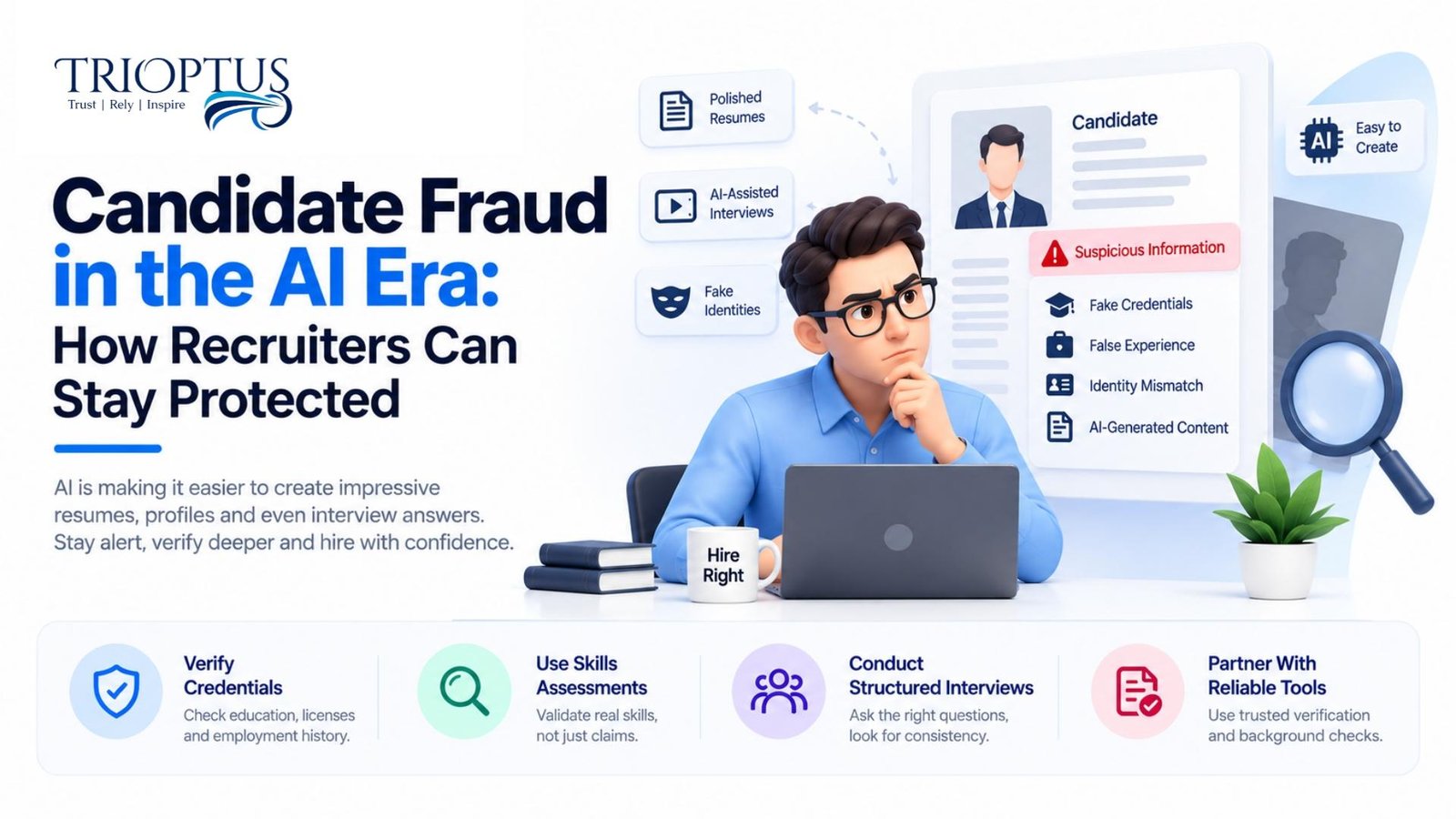
Candidate fraud occurs when an applicant intentionally provides false or misleading information during the hiring process.
This can range from exaggerating skills on a resume to using someone else's identity or submitting falsified credentials.
AI has added another layer to the problem because creating convincing digital content has become easier than ever.
Common examples include:
- False or exaggerated work experience.
- Fake educational qualifications.
- Altered certificates or documents.
- Misrepresented technical skills.
- Fake references.
- Identity impersonation.
- AI-generated resumes and profiles.
- Using unauthorized assistance during remote interviews.
Using AI to improve grammar, organize a resume, or prepare for an interview isn't necessarily fraud. The concern arises when technology is used to misrepresent a candidate's identity, qualifications, or abilities.
Why AI Is Changing Candidate Verification
Traditional recruitment often depends heavily on resumes, interviews, references, and background checks. While these remain valuable, recruiters may need to look more closely at whether information provided across different stages of the hiring process is consistent.
Generative AI can create highly polished resumes, professional-looking profiles, written responses, and even realistic images. As a result, the appearance of professionalism alone is no longer enough to establish credibility.
Recruiters should focus on verifiable evidence and demonstrated skills, rather than simply how impressive a candidate's application looks.
Look Beyond the Resume
A resume is an important starting point, but it should not be the only source of information used to evaluate a candidate.
Recruiters can compare the candidate's resume with their application, professional profile, interview responses, references, and other relevant information.
Significant inconsistencies don't automatically mean fraud. People make mistakes, dates can be remembered differently, and resumes can contain formatting errors. However, unexplained contradictions should encourage recruiters to ask reasonable follow-up questions.
Pay attention to:
- Major gaps or inconsistencies in employment history.
- Job titles that don't align with described responsibilities.
- Skills that cannot be demonstrated during evaluation.
- Significant differences between application materials.
- Claims that are difficult to verify.
Verify Identity Properly
Identity verification is becoming increasingly important, particularly for remote and distributed hiring.
Organizations should establish appropriate identity verification procedures that are consistent with applicable laws and company policies. Depending on the role and hiring process, this may include verifying identity documents through trusted processes and confirming that the person participating in interviews is the same individual completing required employment steps.
The objective isn't excessive surveillance. It is ensuring that the organization knows who it is hiring.
Verify Credentials and Employment History
When a role requires specific education, certifications, licenses, or professional experience, those qualifications should be appropriately verified.
Employers can use reputable background-screening providers and, where appropriate, verify credentials with issuing institutions or professional licensing authorities.
Employment history can also be checked through appropriate reference and verification processes.
Important areas to verify:
- Education.
- Professional licenses.
- Required certifications.
- Employment history.
- Relevant references.
- Role-specific qualifications.
Use Skills-Based Assessments
One of the strongest ways to determine whether someone can perform a job is to evaluate the actual skills required for that position.
Instead of relying entirely on resumes and interviews, organizations can incorporate practical assessments, work samples, technical exercises, structured case studies, or job-relevant simulations.
For example, a software developer might complete a coding assessment, while a designer could present a portfolio and explain their creative decisions.
The assessment should measure genuine job-related capability rather than simply testing how well someone can use AI.
Structure Interviews More Effectively
Unstructured interviews can make it difficult to compare candidates consistently.
Structured interviews use predetermined questions and evaluation criteria, allowing recruiters and hiring managers to assess candidates against the same standards.
Behavioral questions can also encourage candidates to describe specific situations from their experience rather than providing generic answers.
Strong interview practices include:
- Ask consistent core questions.
- Request specific examples from past work.
- Ask follow-up questions.
- Use multiple interviewers when appropriate.
- Score responses against predefined criteria.
Don't Treat AI Use as Automatically Fraudulent
AI itself isn't the enemy.
Many legitimate candidates use AI tools to improve writing, research companies, practice interview questions, or organize their job search. These uses can be comparable to using traditional career resources.
The important distinction is between using AI as a productivity tool and using AI to deceive an employer.
Recruiters should therefore avoid rejecting candidates simply because their application appears AI-assisted. Instead, organizations should establish clear policies around acceptable and unacceptable AI use during the hiring process.
Watch for Patterns, Not One "Red Flag"
There is rarely one definitive sign that proves candidate fraud.
A polished resume, unusual communication style, employment gap, or nervous interview performance should not automatically be treated as evidence of dishonesty.
Instead, recruiters should look for multiple inconsistencies that can be objectively investigated.
A professional and fair approach is to verify information through reliable sources rather than making assumptions based on appearance, accent, writing style, location, or other personal characteristics.
Protect Candidate Data Too
Fraud prevention shouldn't come at the expense of candidate privacy.
Recruiters handle sensitive information such as resumes, identification documents, employment history, and background-check information. Organizations should collect only information they legitimately need, restrict access appropriately, and use reputable technology and screening providers.
Companies should also be transparent about how candidate information is collected and used and follow applicable privacy and employment laws.
Create a Multi-Layer Verification Process
No single tool can completely eliminate candidate fraud.
A stronger approach combines several layers of verification:
Resume → Interview → Skills Assessment → Credential Verification → Reference/Background Checks → Final Hiring Decision
Each step provides another opportunity to confirm that the candidate's information and capabilities are consistent.
This approach is more reliable than depending on an AI detector or automated fraud-detection system alone.
Train Recruiters and Hiring Managers
Technology changes quickly, so recruitment teams need continuous education.
Recruiters and hiring managers should understand emerging forms of candidate fraud, how AI can affect recruitment, how to verify information appropriately, and how to distinguish legitimate AI use from intentional deception.
Training should also emphasize fairness. Fraud-prevention practices must be applied consistently to candidates and should avoid creating bias against legitimate applicants.
Teams should understand:
- How AI is changing candidate behavior.
- Common forms of identity and credential fraud.
- Appropriate verification procedures.
- Data privacy responsibilities.
- Structured and fair evaluation methods.
Build Trust Without Creating Fear
The goal of fraud prevention isn't to make recruitment feel like an investigation.
Candidates deserve a professional and respectful experience, while employers deserve confidence that the people they hire genuinely possess the qualifications they claim.
The best approach is verification without unnecessary friction.
Clear expectations, consistent processes, transparent communication, and appropriate technology can help organizations protect themselves while maintaining a positive candidate experience.
Conclusion
AI is changing recruitment on both sides of the hiring process. Candidates can use technology to improve how they present themselves, while bad actors can potentially use the same technology to make false information harder to detect.
Recruiters don't need to fight AI—they need to adapt their hiring processes to an AI-enabled environment.
The strongest defense against candidate fraud is not a single detection tool. It is a thoughtful combination of identity verification, credential checks, structured interviews, skills assessments, reference checks, technology, and human judgment.
As AI continues to evolve, organizations that build verification into their recruitment strategy will be better positioned to protect their teams, maintain hiring quality, and create a fair and trustworthy experience for genuine candidates.